

Rapid 3D Printing
for Microfluidics
Accelerating Innovation with Precision & Speed
Overview

Precision Fabrication from Nano to Macro
HiComp combines multiple 3D printing technologies to meet the diverse structural, resolution, and material needs of microfluidic innovation. From submicron-resolution biochips to millimeter-scale cartridge molds, we support researchers and product developers from concept to production.
Facilities
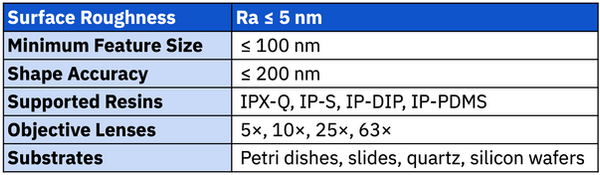
Two-Photon Polymerization (TPP) 3D Printer
Model: Nanoscribe Quantum X bio
Principle: Uses a 780 nm laser to locally polymerize light-sensitive resin for ultra-high precision 3D fabrication.
Applications: Superlenses, microneedles, cell culture scaffolds, microfluidic molds
Max Build Area: 50 × 50 mm

DLP Projection Micro 3D Printer
Model: BMF S230
Principle: Uses digital light projection for high-resolution, rapid prototyping of microscale structures.
Applications: Microneedle arrays, PDMS chip molds, microchannel test structures
Max Build Area: 50 × 50 × 50 mm


3D Printing Plastic Materials with DLP Printer

Resin
Smooth surface, high dimensional accuracy, good toughness, waterproof.

Nylon
Excellent mechanical properties, high chemical resistance, no support structures needed, high strength, high toughness.

Polypropylene
Excellent mechanical properties, waterproof, high chemical resistance, no support structures needed, electrical insulation, high toughness.
Our Resin Materials

Our Nylon Materials

Our Polypropylene Materials

Key Applications in Microfluidics
PDMS mold fabrication for complex microchannel designs
Create reusable or disposable molds with intricate 3D geometries, bypassing the limitations of traditional lithography.
High-resolution microneedle arrays
Fabricate sharp, mechanically robust microneedles with fine feature details for transdermal delivery or sampling.
Custom optical or sensor interfaces
Tailor-make interfaces for integrating micro-optics, electrodes, or embedded detection units into microfluidic systems.
Rapid prototyping of structural components
Accelerate iteration cycles for chip housings, cartridge frames, and functional test fixtures.
Integrated fluidic connectors and adapters
Print complex fittings with precise tolerances for plug-and-play fluidic integration.


Why Choose 3D Printed Microfluidics?
1
Multi-platform capabilitie
From sub-100 nm to millimeter-scale fabrication
2
Material flexibility
Compatible with biocompatible, optical, and elastomer-compatible resins
3
Custom development
Print optimization, size tuning, and integration support
4
Microfluidic expertise
Designed for fluid sealing, flow paths, and downstream assembly
5
Rapid turnaround
Prototypes ready within 48 hours
Applications
• Microneedle arrays and molds
• PDMS microfluidic chip molds
• Cell culture microenvironments
• Optical metasurfaces and micro-lens arrays
• Microchannel networks and integrated fittings
