

\ OVERVIEW
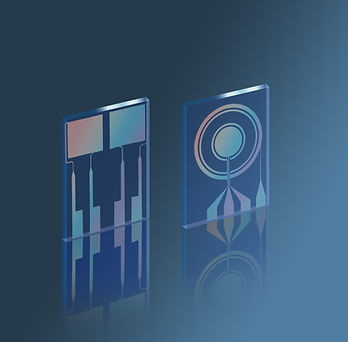
Glass microfluidics
Glass serves devices that plastics cannot — those that require deep-UV excitation or near-zero autofluorescence, handle aggressive solvents, or operate at pressures and temperatures that would deform a polymer.
We fabricate glass microfluidics two ways: photolithography with deep reactive-ion etching for channels, wells and pillar arrays with vertical sidewalls, and femtosecond-laser selective etching for three-dimensional geometry and through-glass vias (TGVs).
Finishing stays in house, from drilling and electrode patterning through bonding, dicing and inspection.
Orders start at a single wafer or slide, and the same processes carry a design from prototype to volume production.

1 µm
minimum feature size


Ra < 2 nm
polished substrate surface


≥ 50:1
through-glass via aspect ratio


2 routes
Femtosecond laser machining, DRIE


ISO 13485
Certified · FDA registered

\ CAPABILITIES
Capabilities and Technical Specifications
DEEP ETCHING — MICROSTRUCTURE
Substrate thickness
0.1–2.0 mm
Thickness uniformity
±5 µm
Surface roughness (Ra)
< 2 nm on polished surfaces. As-etched channel floors are rougher, quoted per feature
Channel size
Length ≥ 50 µm; width ≥ 10 µm
Minimum feature size
1 µm
DEEP ETCHING — MICROWELL AND PILLAR ARRAYS
Feature size, well or pillar
Down to 2 µm
Aperture diameter
> 0.1 µm
Aperture uniformity
CV < 5%
Aspect ratio
< 10
Sidewall tilt angle
80–90°
Hole pitch
> 0.1 µm
LASER MACHINING — GLASS DRILLING
Aperture diameter
0.04–10 mm
Edge chipping
< 3 µm
Position accuracy
±25 µm
LASER MACHINING — THROUGH-GLASS VIAS (TGV)
Aspect ratio
≥ 50:1, material-dependent
Minimum aperture
< 5 µm, material- and thickness-dependent
Via geometries
Straight · tapered · conical · special-shaped
BONDING
Bonding process
Laser · UV · anodic · PSA bonding
Alignment accuracy
±10 µm on aligned multilayer work
Material combinations
Glass-to-glass · glass-to-silicon · glass-to-polymer
Downstream
Dicing to form factor, surface functionalization, integration into assembled devices
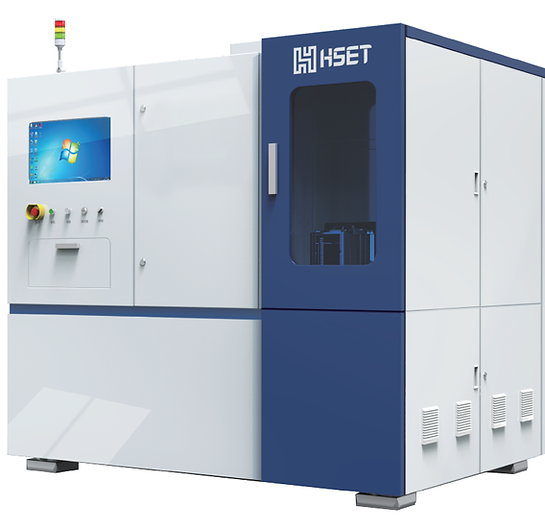
Equipment — FLEE-TGV femtosecond laser platform
.png)
A femtosecond-laser-enhanced glass-via platform for high-precision through-glass microstructures. The laser writes a modified track through the glass and a selective post-etch develops it, which is how vias reach aspect ratios and wall qualities that direct ablation or wet etching alone cannot. Automated wafer calibration and a fully automated workflow support production runs of straight, tapered and conical vias.
Wafer size
4–12 inch
Glass thickness
0.1–1 mm
Processing rate
≥ 5,000 holes/s
Taper angle
1–10° Material-dependent
Positioning accuracy
±5 µm
\ MATERIALS
Glass types
We choose the glass to match the device's optical window, bonding route and thermal budget.
The properties below are typical published values for each glass family; the specific grade is confirmed during DFM review.

Borosilicate (e.g. Borofloat 33)
OPTICAL WINDOW
CTE(ppm/K)
~350–2000 nm, > 90% visible
~3.3
NOTABLE PROPERTY
Contains mobile alkali ions — the standard anodic-bonding glass
Typical use:
General microfluidics, glass-to-silicon devices, flow cells

Fused silica / quartz
OPTICAL WINDOW
CTE(ppm/K)
~190–2500 nm — deep UV
~0.55
NOTABLE PROPERTY
Highest purity and lowest autofluorescence; extremely low expansion
Typical use:
UV excitation, single-molecule detection, high-temperature work

Soda-lime
OPTICAL WINDOW
CTE(ppm/K)
~320 nm and above
~9
NOTABLE PROPERTY
Lowest cost; higher autofluorescence than borosilicate
Typical use:
Cost-sensitive devices with visible-range detection only

Thin display glass (alkali-free alumino-borosilicate)
OPTICAL WINDOW
CTE(ppm/K)
Visible and near-UV
~3–7
NOTABLE PROPERTY
Available in very thin sheet, 0.03–1.1 mm
Typical use:
Imaging-side windows, high-NA objectives, thin flow cells
Fused Silica Bonding Limits
Fused silica lacks alkali ions required for anodic bonding, needing alternative routes like laser or adhesive. Borosilicate is required when silicon anodic bonding is mandatory.
Soda-Lime Optical Trade-Offs
Soda-lime blocks UV (<320 nm) and exhibits higher fluorescence, making it unsuitable for optics. While low-cost, it degrades performance in UV or fluorescence assays.

Materials guide ❯
Grade-level data across every substrate we run, and the three questions that decide material choice

Glass vs. Thermoplastic vs. PDMS
Choose glass when the application needs deep-UV transmission, near-zero autofluorescence, chemical inertness or high pressure; choose molded cyclic olefin (COC/COP) when it does not and volume matters. Choose PDMS for rapid prototyping, high-fidelity replication and applications such as organ-on-a-chip.
Glass
OPTICAL TRANSMISSION
Excellent, including UV in fused silica
AUTOFLUORESCENCE
Negligible
CHEMICAL RESISTANCE
Excellent — solvents, acids, bases
PRESSURE AND TEMPERATURE
Highest of the three
ROUTE TO VOLUME
Batch etch at wafer scale
RELATIVE UNIT COST
High
Thermoplastic
OPTICAL TRANSMISSION
Good visible; UV poor in PC and PS
AUTOFLUORESCENCE
Low in COC/COP, high in PC
CHEMICAL RESISTANCE
Grade-dependent; poor to non-polar solvents
PRESSURE AND TEMPERATURE
Limited by Tg
ROUTE TO VOLUME
Injection molding
RELATIVE UNIT COST
Lowest at volume
PDMS
OPTICAL TRANSMISSION
Good visible
AUTOFLUORESCENCE
Low
CHEMICAL RESISTANCE
Swells in non-polar solvents
PRESSURE AND TEMPERATURE
Lowest
ROUTE TO VOLUME
Casting
RELATIVE UNIT COST
Medium
\ PROCESS
Glass fabrication process
Two forming routes, DRIE and femtosecond laser, chosen on the feature and each scalable to production; both merge into one finishing line (steps 4‑8). One partner throughout, under ISO 13485.
-
Route A Photolithography and DRIE — masked features with vertical sidewalls

Design & DFM
Substrate and bond selected together; checked against etch bias and dicing lanes.
Free DFM review

Photolithography
Mask and resist define the features to be etched.
1 µm min. feature

DRIE / wet etch
Etched to depth; sidewalls held vertical.
Sidewalls 80–90°
-
Route B Femtosecond laser and selective etch — 3D geometry, through-glass vias

Design & DFM
Geometry written as a laser file; substrate and thickness confirmed for the aspect ratio.
Free DFM review

Laser writing
The femtosecond laser writes a modified track through the glass.
≥ 5,000 holes/s

Selective etch
Post-etch develops the written track into a via or channel.
TGV to 50:1
↓ Both routes merge into common finishing ↓
-
Finishing Common to both routes

Drilling
Laser drilling of ports, 0.04 to 10 mm, edge chipping under 3 µm.
±25 µm position

Electrodes
Where the device is active: metal deposited and patterned directly on the glass.
EWOD · impedance · heaters

Bonding
Laser, UV, anodic or PSA, chosen for the material pair and thermal budget. Aligned and inspected.
±10 µm alignment

Dicing & finishing
Singulation to the customer form factor, edge finishing, cleaning.
Customer form factor

Inspection& packaging
Dimensional & optical inspection, leak test, packaging.
Ships in wafer boxes

\ QUALITY CONTROL
Inspection and validation

Feature dimensions
Aperture uniformity
Bond integrity
Quality system
Depth and roughness
Bond alignment
Cleanliness
\ LEAD TIME & MOQ
Lead time, Minimum order and Delivery

Standard lead time
Delivery within 4–6 weeks; complex or multi-process runs are evaluated and quoted individually.

Minimum order
Minimum order starting from just one wafer/slide to support flexible initial prototyping.

Delivery format
Protective film applied to the surface, packed in wafer boxes

Design changes
Design updates rely on mask or laser file edits rather than expensive tooling resets.
\ SHOWCASE
Sample parts and applications
FAQ


