

Custom Microfluidic Devices for Drug Delivery
Advanced therapeutic delivery systems powered by precision microfluidic engineering.
01 • THE CASE FOR MICROFLUIDIC DRUG DELIVERY
Why Microfluidics?
Reasons microfluidic devices are revolutionizing pharmaceutical delivery systems for next-generation therapeutics.
Precision-controlled delivery
Microfluidic devices enable unprecedented control over drug formulation, particle size, and release kinetics, making them ideal for advanced therapeutics including lipid nanoparticles, biologics, and targeted delivery systems.
ADVANTAGES OVER CONVENTIONAL METHODS
-
Enhanced mixing control for consistent particle formation
-
Precise dosing with improved bioavailability
-
Reduced manufacturing variability
-
Scalable production from lab to commercial volumes
-
Better compatibility with sensitive biologics
Therapeutic versatility
From inhaled medications to transdermal patches and implantable devices, microfluidic platforms adapt to diverse delivery routes and therapeutic modalities that conventional manufacturing cannot address.
KEY APPLICATION AREAS
-
Lipid nanoparticle synthesis for mRNA and gene therapies
-
Soft mist inhalation for pulmonary delivery
-
Microneedle platforms for transdermal applications
-
Sustained-release implantable systems
-
Point-of-care therapeutic preparation
02 • MANUFACTURING EXCELLENCE
Integrated Development Path
HiComp combines prototyping capabilities with production-scale manufacturing to accelerate your journey from concept to commercial device.
Comprehensive technology stack
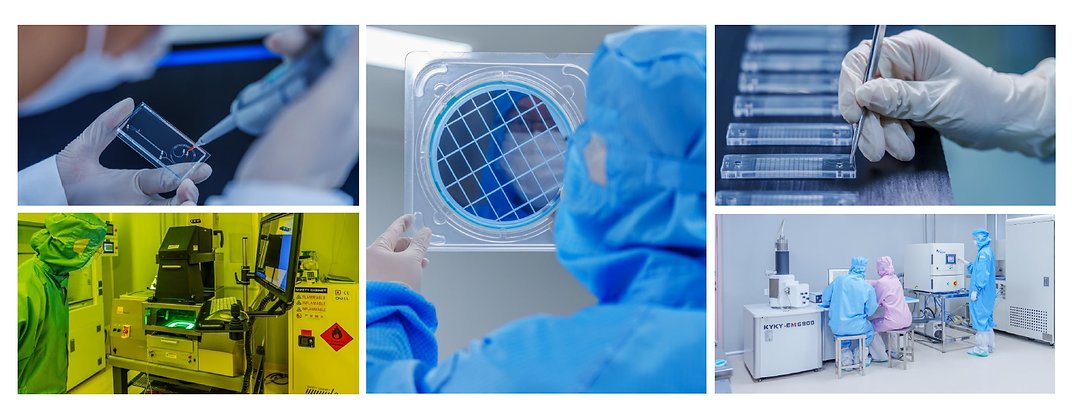
Our integrated approach eliminates the need for multiple suppliers, providing everything from initial PDMS prototypes to commercial-grade thermoplastic devices with full quality certification.
CORE CAPABILITIES
-
PDMS rapid prototyping and validation
-
COC and thermoplastic commercial production
-
MEMS microstructure fabrication
-
Multiple bonding technologies (thermal, ultrasonic, laser, solvent, PSA)
-
ISO 7 cleanroom manufacturing environment
-
ISO13485 and ISO9001 quality systems

03 · PARTNERSHIP
Why partner with HiComp?
HiComp bridges the critical gap between pharmaceutical innovation and commercial reality, transforming complex drug delivery challenges into manufacturable solutions that meet FDA standards.
Advanced microfluidic integration for next-generation pharmaceutical delivery systems
We help pharmaceutical innovators move from feasibility studies to deployable delivery systems faster, with manufacturing rigor built in from the first prototype.
CORE CAPABILITIES
-
Microfluidic device design optimization for therapeutic applications
-
Rapid prototyping and pilot production for drug delivery systems
-
Injection molding scale-up for commercial manufacturing
-
Biocompatibility and regulatory compliance engineering
-
Integrated formulation-device development workflows
Drug delivery innovation represents a major shift toward patient-centric therapeutics. With advances in microfluidics and precision manufacturing, controllable therapeutic delivery is becoming a cornerstone of next-generation pharmaceutical development.
CASE STUDIES
Case Study 1
Microfluidic LNP Synthesis Platform: Advanced Lipid Nanoparticle Manufacturing System
HiComp utilizes advanced microfluidic integration to transform lipid nanoparticle synthesis from traditional batch processing to continuous, automated production. By integrating precision MEMS fabrication with thermoplastic chip manufacturing, our platform delivers consistent particle formation and scalable production capabilities, making it ideal for commercial pharmaceutical applications requiring high-quality LNP synthesis.

Technology
-
PDMS Prototype Development: Rapid validation using polydimethylsiloxane chips with transparent, chemically stable properties.
-
COC Commercial Production: Thermoplastic chips optimized for pharmaceutical manufacturing with superior chemical resistance.
-
MEMS Microstructure Precision: Advanced microfabrication achieving >0.003mm accuracy with ±0.001mm dimensional control.
-
Multi-Bonding Technologies: Comprehensive bonding capabilities including thermal, ultrasonic, laser, and solvent methods.
Performance
-
Automated Synthesis Workflow: Replaces manual preparation with seamless, automated lipid-aqueous phase mixing control.
-
Enhanced Production Consistency: Achieves superior particle size uniformity compared to traditional bulk synthesis methods.
-
Scalable Manufacturing: Enables transition from lab-scale validation to commercial production with maintained quality.
-
Quality Assurance Integration: Ra0.02 surface roughness and >0.6MPa pressure resistance with comprehensive testing.
Applications
-
mRNA Vaccine Production: Optimized platform for COVID-19, influenza, and next-generation mRNA therapeutic delivery.
-
Gene Therapy Delivery: Advanced LNP synthesis for gene editing applications including CRISPR delivery systems.
-
Pharmaceutical Manufacturing: Commercial-scale production capabilities for biotech companies transitioning to clinical trials.
-
Research & Development: Rapid prototyping platform enabling pharmaceutical researchers to optimize formulation parameters.
Case Study 2
Soft Mist Inhaler Core Module: Precision MEMS Aerosol Generation Platform
HiComp utilizes advanced MEMS microfabrication to develop precision aerosol generation systems for pharmaceutical inhalation devices. By integrating silicon-based microstructures with specialized processing workflows, our platform delivers consistent droplet formation and optimal lung deposition for respiratory therapeutics.


Technology
-
Silicon MEMS Fabrication: Utilizes precision micromachining to create microscale nozzle arrays with sub-micron dimensional control for uniform aerosol generation.
-
Critical Dimension Control: Maintains < 5% variance in height uniformity and inlet/outlet dimensions through specialized gap-filling and automated inspection processes.
-
Multi-layer Architecture: Integrates silicon wafer structures with glass components and filter systems for complete aerosol delivery functionality.
-
Protective Processing: Advanced dicing technologies maintain the integrity of channel inlets and outlets, ensuring clean edge control and preventing damage during chip separation.
Performance
-
Precise Droplet Control: Achieves target 1-5 μm particle size distribution with <10% coefficient of variation across production batches.
-
Enhanced Lung Deposition: Delivers 40% improvement in fine particle fraction compared to conventional metered-dose inhalers, optimizing therapeutic efficacy.
-
Production Consistency: Automated QC handling with pick-and-place orientation control ensures rigorous dimensional consistency across high-volume manufacturing.
-
Regulatory Compliance: Meets FDA requirements for inhaled drug delivery devices with full validation documentation and quality systems integration.
Applications
-
Respiratory Therapeutics: Optimized delivery platform for bronchodilators, corticosteroids, and combination therapies requiring precise lung targeting.
-
Biological Formulations: Compatible with protein and peptide therapeutics that require gentle handling and controlled aerosol characteristics.
-
Pediatric Medicine: Soft mist technology suitable for patients with limited coordination capabilities, improving medication compliance.
-
Specialty Pharmaceuticals: Supports novel drug delivery applications including pulmonary gene therapy and targeted oncology treatments.