

Saliva-Based Screening
Next-generation IVD powered by microfluidic integration.
Saliva is emerging as a practical alternative to blood for a growing range of molecular tests. The shift is driven by three converging trends: the decentralization of diagnostic testing beyond the central laboratory, the maturation of microfluidic sample preparation, and a rapidly expanding evidence base for saliva biomarkers across infectious disease, oncology, and endocrinology. The widespread deployment of FDA-authorized at-home molecular platforms during the COVID-19 pandemic established both the regulatory precedent and the consumer acceptance that the broader saliva-diagnostics field now builds on.
This note surveys the technology landscape behind that shift, including what saliva offers as a diagnostic matrix, the sensitivity and sample-preparation challenges that long limited its use, the microfluidic techniques that now address those challenges, and the clinical and commercial applications coming online as a result.
01 · THE CASE FOR SALIVA
Why Saliva?
Two dimensions are driving saliva's adoption as a front-line matrix for decentralized molecular testing: the patient experience of collection, and the operational reach of deployment. Both have improved substantially with the maturation of microfluidic sample preparation, making saliva-based workflows viable in clinical settings where blood draws are impractical or contraindicated.
Patient-centered sampling
Saliva collection eliminates needles, trained personnel, and clinical infrastructure, making it ideal for pediatric, geriatric, chronic-disease, and at-home testing.
ADVANTAGES OVER BLOOD SAMPLING
-
Non-invasive collection with improved patient compliance
-
Safe, repeatable sampling for longitudinal monitoring
-
Reduced biohazard handling requirements
-
Self-collection outside hospital settings
Decentralized reach
Saliva-based assays move diagnostics from centralized laboratories to the point of need, reducing cost per test and expanding accessibility across healthcare systems.
DEPLOYMENT MODELS ENABLED
-
Non-invasive collection with improved patient compliance
-
Safe, repeatable sampling for longitudinal monitoring
-
Reduced biohazard handling requirements
-
Self-collection outside hospital settings
02 · BIOLOGICAL BASIS
Saliva as a diagnostic matrix
Saliva is a complex biofluid that reflects systemic physiology through the blood–saliva barrier. It contains broadly the same molecular classes found in plasma including nucleic acids, proteins, metabolites, extracellular vesicles, and immunoglobulins, along with a distinctive oral microbiome. Over the past decade, a substantial body of research has validated saliva for a widening set of clinical targets, establishing it as more than a convenience matrix.
Detectable biomarker classes
-
Cell-free DNA and RNA, including circulating miRNAs
-
Extracellular vesicles and exosomes
-
Proteins, peptides, and inflammatory cytokines
-
Metabolites (cortisol, glucose, small-molecule drugs)
-
Secretory and serum-derived immunoglobulins
-
Oral microbiome signatures
Pre-analytical considerations
-
Diurnal variation for several hormonal and metabolic analytes
-
Viscosity and mucin content affecting liquid handling
-
Nuclease and protease activity affecting target stability
-
Sensitivity to collection method (passive drool, swab, stimulated)
03 · ENABLING TECHNOLOGIES
The sensitivity barrier and microfluidic solutions
The principal technical challenge in saliva diagnostics is analyte concentration. Clinically relevant nucleic acid and protein targets typically appear at levels 10–1,000× lower in saliva than in plasma, while high-abundance background components such as alpha-amylase can account for 30–50% of total protein. Integrated microfluidic cartridges address this by combining selective depletion, on-chip preconcentration, and reaction-integrated detection in a closed, single-step workflow, replacing the multi-instrument laboratory pipeline that blood-based assays have historically required.
Sample preparation
-
Magnetic-bead capture with functionalized surface chemistry
-
Filter- and membrane-based separation of high-abundance proteins
-
Affinity depletion of alpha-amylase and mucins
-
On-chip lysis and nucleic acid extraction
Amplification and detection chemistry
-
Isothermal amplification (LAMP, RPA, RCA) for instrument-free thermal control
-
CRISPR-Cas readouts (SHERLOCK, DETECTR) for single-nucleotide specificity
-
Lyophilized reagent formats for room-temperature storage
-
Multiplexed panels targeting 3–7 analytes per cartridge
Readout integration
-
Capillary-driven lateral flow strips for visual interpretation
-
Fluorescence detection for quantitative and multiplexed readouts
-
Electrochemical sensing for compact, low-power devices
-
Smartphone-based imaging with machine-learning assisted interpretation
04 · CLINICAL DEPLOYMENT
Application landscape
Commercial deployment accelerated starting from 2020 with at-home molecular test for respiratory infection, and has since expanded into a broader set of clinical and consumer-health indications. The common thread across these applications is a shift from centralized laboratory testing to decentralized, self-administered workflows enabled by the combination of saliva collection and cartridge-level microfluidic integration.
Active and emerging indications
-
Respiratory pathogens (SARS-CoV-2, influenza, RSV)
-
Sexually transmitted infections
-
Group A Streptococcus and pharyngitis panels
-
Oncology biomarkers (HPV, head and neck)
-
Hormone and stress monitoring (cortisol, testosterone)
-
Drug-of-abuse and therapeutic drug monitoring
-
Pediatric and geriatric diagnostics
-
Population-scale screening and surveillance
05 · PARTNERSHIP
Why partner with HiComp?
HiComp provides the microfluidic engineering infrastructure required to translate saliva-based assays into manufacturable diagnostic products.
Precision manufacturing for next-generation platforms
We help diagnostic innovators move from feasibility studies to deployable screening systems faster, with manufacturing rigor built in from the first prototype.
CORE CAPABILITIES
-
Microfluidic cartridge design optimization
-
Rapid prototyping and pilot production
-
Injection molding scale-up
-
Optical and biochemical compatibility engineering
-
Integrated sample preparation workflows
Saliva-based screening represents a major shift toward accessible, patient-friendly diagnostics. With advances in microfluidics and AI-assisted biomarker interpretation, non-invasive testing is becoming a cornerstone of next-generation healthcare.
CASE STUDIES
Case Study 1
Integrated Saliva-Based Multiplex Screening: A Seamless Sample-to-Result Platform
We utilize HiComp’s advanced microfluidic integration to transform non-invasive saliva testing. By automating sample dilution, filtration, and distribution through a pre-filled buffer system, the platform eliminates the need for manual pre-processing. This "Sample-to-Result" workflow delivers lab-accurate diagnostic panels directly at the point of care, making it ideal for high-throughput screening in diverse environments.

Technology
-
Capillary-Driven Logic: Uses microfluidic capillary drive to manage liquid handling without external power.
-
On-Board Processing: Pre-filled buffer chambers automate sample dilution and distribution.
-
Scalable Panels: Multi-channel architecture (supporting up to 7 channels) enables simultaneous biomarker detection.
-
Closed System: Fully integrated cassette ensures all handling is contained to prevent contamination.
Performance
-
Automated Workflow: Replaces labor-intensive manual dilution with a seamless, automated "Sample-to-Result" microfluidic process.
-
High Throughput: Enables multiplexing of up to 7 analytes, significantly increasing efficiency over traditional single-analyte kits.
-
Simple Operation: Simplifies complex laboratory procedures into a "Collect-to-Test" operation suitable for non-professional users.
-
Precision Control: Utilizes micro-channel technology to ensure consistent sample measurement, replacing imprecise manual handling.
Applications
-
Respiratory Panels: Simultaneous screening for COVID-19, Influenza A/B, and RSV from a single, non-invasive sample.
-
Field Screening: High-throughput solution for rapid drug testing and efficient workplace wellness monitoring.
-
Specialized Care: Provides a pain-free diagnostic alternative for pediatric and geriatric patients who struggle with blood draws.
-
Biomarker Assessment: Supports diverse testing models for quantitative assessment of hormones or other critical health markers.
Case Study 2
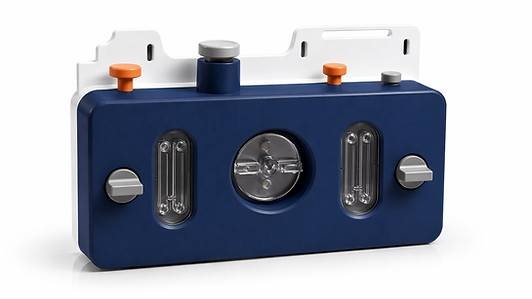
Modular LAMP Cartridge: An Direct Drive Saliva-to-Strip Workflow for Pathogens At Home Test
We combine saliva sample preparation, isothermal LAMP amplification, and lateral-flow readout into a single closed, unpowered consumable. Color-coded actuation buttons replace laboratory equipment with an intuitive stepwise workflow, delivering lab-grade molecular diagnostics for pathogens directly in the home environment, at a sub-$10 unit cost target.
Technology
-
Magnetic Bead Capture: Functionalized beads enrich pathogen targets directly from saliva, eliminating centrifugation and manual extraction.
-
Unpowered Fluid Drive: Compressed-air plunger and rotary valve architecture moves all liquids without pumps, motors, or electronics.
-
Lyophilized LAMP: Pre-loaded freeze-dried reagents enable room-temperature storage and one-step isothermal amplification at 65 °C.
-
Integrated Readout Card: A capillary-driven detection card auto-wicks amplified product onto the strip — no manual pipetting.
Performance
-
End-to-End Workflow: Six color-coded steps take users from saliva collection to a visual result in a single closed cassette.
-
Isothermal Speed: Delivers PCR-comparable sensitivity in ~30 minutes without thermal cycling hardware.
-
Visual Interpretation: Classic control/test-line format on the lateral flow strip enables unambiguous reading by non-professional users.
-
Cost-Optimized by Design: Engineered from Phase 1 against a <$10 unit cost target for high-volume manufacturing.
Applications
-
Pediatric Tests:
-
Rapid pediatric triage without a clinic visit.
-
Respiratory Pathogen Panels: Platform adapts to influenza A/B, RSV, and SARS-CoV-2 from a single saliva sample.
-
Privacy-Sensitive Screening: Discreet at-home molecular detection for STIs and similarly sensitive conditions.
-
Emergency & Field Deployment: Handheld, unpowered format suited to outbreak response, remote clinics, and low-resource settings.